
A legacy of ancestral medicine supported by modern science and phytotherapy. In recent years, natural medicine has gained an increasingly important place in the search for less invasive and more harmonious therapeutic alternatives. Among the plants that have attracted the most scientific and medical attention is the Plant of Life (Synadenium grantii), also known as the African Milk Bush, Janaúba, or Euphorbia umbellata.
This shrub, native to tropical Africa, has been the focus of numerous studies and real-life testimonies that highlight its extraordinary medicinal potential for treating a wide range of diseases—from mild ailments to serious conditions such as cancer, diabetes, and lupus.
Peruvian integrative doctor Dr. Oscar I. Vilca-Romero has extensively emphasized the healing power of this species within natural and complementary medicine. Through his clinical practice, he has documented hundreds of recovery cases in patients who, after being declared terminal by conventional medicine, found new hope in this powerful plant.
It may interest you: The Water of Life: Secrets of the African Milk Bush
Video: Planta de la Vida o Lechero Africano
🌱 Origin, Characteristics, and Composition of Synadenium grantii
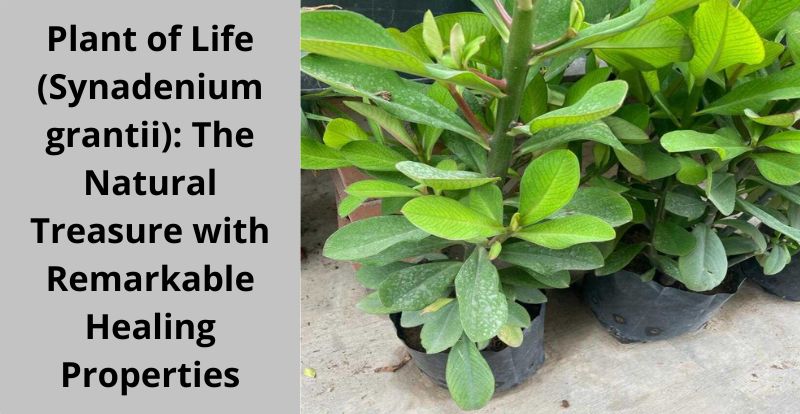
The Plant of Life belongs to the Euphorbiaceae family and the Malpighiales order. It is a monoecious shrub or small tree that grows between 4 and 5 meters tall, featuring cylindrical, fleshy green stems that become woody over time. Its grayish, scaly bark protects a milky-white latex, which holds the greatest medicinal value.
The leaves are thick, fleshy, and obovate, with a deep green color and sometimes a purplish hue on the underside. Its flowers are small, axillary, and lack petals or sepals. This plant thrives in warm, tropical climates where sunlight and well-drained soils promote vigorous growth.
From a medicinal standpoint, the most important active compound of Synadenium grantii is Phorbol, a diterpene ester known for its ability to influence complex cellular processes. It plays a role in tissue regeneration, immune modulation, and inhibition of abnormal cell growth—making it a compound of great therapeutic interest.
💧 Extraction and Use of the Latex and Leaves
The latex of the Plant of Life is traditionally extracted by making small cuts in the stems or branches, allowing the white liquid to flow slowly. It can also be obtained during pruning or propagation. A sharp knife should be used, and the latex should be collected in glass or enamel containers.
For immediate use, the latex may be diluted with boiled or mineral water. To preserve it for longer periods, it should be stored pure, without dilution.
The leaves can be harvested together with the latex and used either fresh or dried. If not processed immediately, they should be kept in cool, shaded places, spread on cloths or placed in open containers. It is advisable not to store them for more than three days, as they lose their color and medicinal potency. Once dried, they can be pulverized to prepare natural extracts or capsules.
🌼 Therapeutic Uses and Natural Treatments with the Plant of Life
Traditional medicine and the empirical studies of Dr. Vegan (Oscar Vilca-Romero) have identified numerous applications of Synadenium grantii. Its therapeutic use extends from inflammatory and viral diseases to degenerative disorders. Treatments vary in duration and dosage depending on the severity of the condition and the patient’s response.
🔹 Short-Term Treatments (7 to 30 days)
- Acute inflammation
- Dengue and flu
- Muscle and joint pain
- Dandruff, fungi, and skin disorders
- Intestinal parasites
- Pneumonia and appendicitis
In these cases, the diluted latex works as an antibacterial, anti-inflammatory, and cellular regenerator, accelerating the body’s recovery.
🔹 Medium-Term Treatments (30 to 90 days)
- Kidney and gallstones
- Stress, depression, and blood toxicity
- Tuberculosis, asthma, sinusitis, gastritis, and high cholesterol
- Vitiligo, prostatitis, myomas, cysts, and benign tumors
During this phase, oral consumption is combined with topical application, alongside a natural diet low in fats and rich in fruits and vegetables.
🔹 Long-Term Treatments (90 to 180 days)
- Diabetes, lupus, rheumatoid arthritis, and psoriasis
- Parkinson’s, epilepsy, osteoarthritis, and autoimmune diseases
Over this period, the body requires time to regenerate damaged tissues and restore immune balance. According to Dr. Vilca-Romero, emotional stability and healthy nutrition play a vital role in achieving lasting results.
🧬 Phorbol and Its Action on Human Cells
One of the most fascinating aspects of Synadenium grantii is the function of Phorbol, its main active compound. This natural molecule can act on genetic regulators related to cell division and tissue repair—especially the TSC1 and TSC2 genes, known as tumor suppressor genes.
Phorbol helps stabilize the molecular structure of damaged cells, promoting regeneration while preventing uncontrolled cell proliferation. This process is not only beneficial in cancer treatment but also plays a role in preventing degenerative diseases and repairing genetic damage caused by environmental or dietary factors.
Thus, the Plant of Life is more than a natural remedy—it functions as a biological catalyst that stimulates the body’s innate healing mechanisms.
🩺 Therapeutic Results in Different Types of Cancer
Numerous testimonials and alternative medical reports have documented remarkable outcomes in various types of cancer, including breast, cervical, liver, lung, and skin cancer.
- In breast cancer, tumors tend to soften within 25 days of treatment.
- In cervical cancer, lesions disappear completely after about 60 days.
- In liver and lung cancer, tissues regenerate within approximately two months.
- In cases of gangrene, dead tissues regenerate within 15 days, with full recovery in 30.
Even in terminal stages, patients have shown notable improvements in overall health, appetite, and vitality. According to Dr. Vegan’s data, recovery occurs in 60% to 70% of cases, depending on disease progression and the patient’s discipline during treatment.
💊 Safety, Precautions, and Usage Recommendations
Despite its powerful medicinal properties, the latex of Synadenium grantii can be toxic if misused. Direct contact with skin or eyes can cause severe irritation, so protective gloves and goggles should always be worn when handling the plant.
Internal consumption must be done only under medical or phytotherapeutic supervision, strictly following prescribed doses. The plant should not be administered to pregnant women, young children, or individuals with liver conditions without professional guidance.
🌎 A Gift from Nature for Holistic Well-being
Beyond its effectiveness in serious diseases, the Plant of Life is also valued for strengthening the immune system, purifying the blood, and boosting physical and mental vitality. Its regenerative action makes it a valuable ally for those seeking a balanced and natural lifestyle.
Synadenium grantii represents the connection between ancestral African wisdom and modern natural medicine. Research continues to expand in botanical laboratories, research centers, and integrative medical practices—especially in Peru and Brazil, where the plant has adapted well to tropical climates.
✨ Conclusion
The Plant of Life (Synadenium grantii) is a shining example of how nature can provide powerful solutions to health challenges that modern science is still working to solve. Its latex and leaves contain bioactive compounds capable of regenerating tissues, modulating genetic functions, and strengthening the body holistically.
While its use must be careful and supervised, there is no doubt that its healing potential opens a hopeful path toward a more human, natural, and sustainable approach to medicine.
As Dr. Oscar I. Vilca-Romero wisely says: “True health is not only achieved by eliminating disease but by restoring the balance between body, mind, and nature.”
Reference
Prof. Namrita Lall, Ph.D.
Professor of Plant Sciences, University of Pretoria – Specialist in Medicinal Plant Research & Ethnopharmacology
“Her research emphasises how indigenous knowledge systems and medicinal plants with bioactive compounds can contribute to new treatments for diseases such as cancer and infections.”
About Prof. Namrita Lall:
Prof. Lall leads the South African Research Chair for Plant Health Products from Indigenous Knowledge Systems at the University of Pretoria. Her work focuses on identifying, validating and translating medicinal plants into therapeutic leads—especially those used by traditional communities for ailments like cancer, tuberculosis, and other serious health conditions. She has published widely on plant-based bioactive compounds and holds a strong reputation in pharmacognosy and phytomedicine research.