
Fear and doubt are two of the most powerful and universal human emotions. Although they were born with an adaptive purpose—to protect us from danger and help us survive—in modern life, they can become invisible prisons that limit our growth, relationships, and dreams.
For years, many of us have felt the weight of those inner voices whispering, “You’re not good enough,” or “What if you fail?” These emotions, if left unmanaged, can paralyze us, prevent bold decisions, and slowly erode our self-confidence. Yet both doubt and fear can become powerful teachers when we learn to understand and face them with awareness.
It may interest you: 7 Paths to Inner Calm: How to Build Lasting Peace from Within
Video: The Invisible Prison of the Mind | How to Find True Inner Freedom
What Is Doubt, Really?
Doubt is a mental state where the mind swings between confidence and insecurity. It’s that uncertainty that arises when we’re unsure about our decisions, abilities, or the future. However, doubting does not mean weakness—it’s a natural response to the unknown.
Accepting doubt as part of being human is the first step to overcoming it. Repressing or ignoring it only makes it stronger. When we acknowledge it with humility, we transform it into an opportunity for growth.
Strategies to Face Doubt
- Recognize and accept your emotions. Self-compassion is essential. Instead of judging yourself for feeling insecure, observe the feeling with curiosity. Acceptance weakens its hold.
- Take care of your body to heal your mind. Proper sleep, balanced nutrition, and regular exercise reduce the anxiety that feeds doubt.
- Sit with discomfort. Don’t rush to distract yourself every time uncertainty appears. Learn to be present, even when the mind demands immediate answers.
- Seek new experiences. Challenge yourself with something unfamiliar or step outside your comfort zone. Each small achievement becomes proof that you’re more capable than you believed.
Doubt itself isn’t the problem; the real challenge lies in how we choose to manage it.
Fear: Understanding Its Function and Its Trap
Fear is a primary emotion that activates in response to perceived threats, real or imagined. Its original purpose was to keep us safe. But today, when we no longer run from predators but from judgment, failure, or change, fear disguises itself as caution and steals our opportunities.
Fear takes many forms: fear of failure, of making mistakes, of rejection, of change, or even of being truly ourselves. At its core, every fear stems from the same place—the fear of losing something valuable, such as security, love, status, or control.
The Brain and Fear
When fear strikes, the body reacts before the mind can think. The amygdala triggers an alert response: the heart races, pupils dilate, and the body prepares to fight or flee. This reaction is helpful in real danger—but when the threat exists only in our imagination, the same mechanism becomes destructive.
Constant stress generated by imagined fears leads to physical and emotional exhaustion. Understanding fear is, therefore, the first step toward freeing ourselves from it.
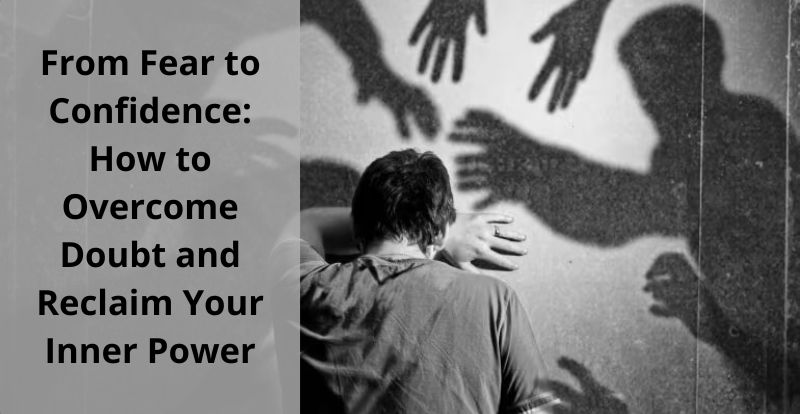
Turning Fear Into Inner Power
Overcoming fear doesn’t mean erasing it—it means learning to live alongside it. As Nelson Mandela once said, “Courage is not the absence of fear, but the triumph over it.”
A Step-by-Step Plan to Overcome Fear and Doubt
Over the years, many have used simple yet powerful strategies to handle these emotions. Here’s a practical guide:
- Understand the problem. Identify where the fear comes from. Is it real or a projection of your thoughts?
- Define a course of action. Clarity is the antidote to confusion. When you have a plan, fear loses its grip.
- Take action despite fear. Action is the most effective cure for paralysis. Each step you take reduces fear’s intensity.
- Acknowledge your achievements. Celebrate every victory, no matter how small—it strengthens self-trust.
- Learn from mistakes. Failure isn’t a sentence—it’s feedback. Ask, “What does this teach me?” and move forward.
Repeat this process as often as necessary. Over time, what once terrified you will no longer hold the same power.
The Connection Between Fear, Love, and Trust
Fear and trust are opposites on the same emotional scale. When one grows, the other diminishes. Love—understood as deep acceptance of ourselves and others—is the bridge that transforms fear into trust.
Fearful Love vs. Trusting Love
Many times, without realizing it, we act from a love filled with fear. Parents who overprotect their children, leaders who micromanage their teams, or partners who constantly doubt each other do so out of fear: fear of loss, fear of failure, fear of not being enough. Yet this kind of love limits the other person’s growth.
Trusting love, on the other hand, allows others to make mistakes, explore, and learn. When we trust, we transmit security and give wings to those around us. Trust is the most powerful antidote to fear—in families, organizations, and society.
How to Cultivate Inner Trust
- Believe in your inner resources. Remember the moments when you overcame what seemed impossible.
- Surround yourself with inspiring people. Confidence is contagious. Being near those who believe in you strengthens your own belief.
- Transform your inner dialogue. Replace “I can’t” with “I’m learning.”
- Practice gratitude. Appreciating what you already have connects you to abundance and dissolves the fear of loss.
- Act with love. Authentic love doesn’t seek to control or protect out of fear—it supports others from freedom.
The Role of Fear in Our Evolution
Fear is not our enemy. It has helped humanity survive, learn from mistakes, and prepare for change. But in today’s world, survival no longer means escaping physical danger—it means adapting emotionally and mentally to uncertainty.
To survive now is to be resilient, flexible, and creative. It’s trusting in our ability to reinvent ourselves and rise again, even when the future feels uncertain.
From Fear to Love: The Path to Inner Freedom
As Frank Herbert wrote in Dune:
“I will face my fear. I will permit it to pass over me and through me. And when it has gone past, I will turn the inner eye to see its path. Where the fear has gone, there will be nothing. Only I will remain.”
This timeless passage reminds us that fear is only a shadow that fades when we confront it with light.
Every time we turn doubt into curiosity and fear into action, we reclaim a piece of our personal power. Each act of trust—whether in life, love, or ourselves—strengthens the mind, body, and spirit.
The journey to overcoming fear and doubt isn’t easy, but it’s profoundly liberating. Because in the end, when fear dissolves, what remains is who we truly are: beings capable of creating, loving, and trusting.
Conclusion: Choosing Trust Every Day
Fear will never disappear entirely, but we can learn to live without letting it control us. Each time you choose love, faith, and gratitude over fear, you take a step toward inner freedom.
Remember:
- Fear is natural.
- Doubt is human.
- But trust is a choice.
And that choice is entirely yours.
Reference
Dr. Rob Yeung, Ph.D.
Chartered Psychologist, Author & Confidence Specialist
About Dr. Rob Yeung:
Dr. Rob Yeung is a British psychologist with a Ph.D. in Psychology from King’s College London and holds Chartered Psychologist status through the British Psychological Society. He is widely recognized for his expertise in confidence, performance psychology, and helping individuals move from fear to self-belief. He has authored numerous articles and books (such as 10% Better: Easy Ways to Beat Stress, Think Smarter, Get Healthy and Achieve Any Goal) and regularly appears in media discussing practical strategies for enhancing confidence.